Till We Meet Again Elizabeth Goodine Lyrics
Religion and feminism run across at Feminist Festival prayer acuity
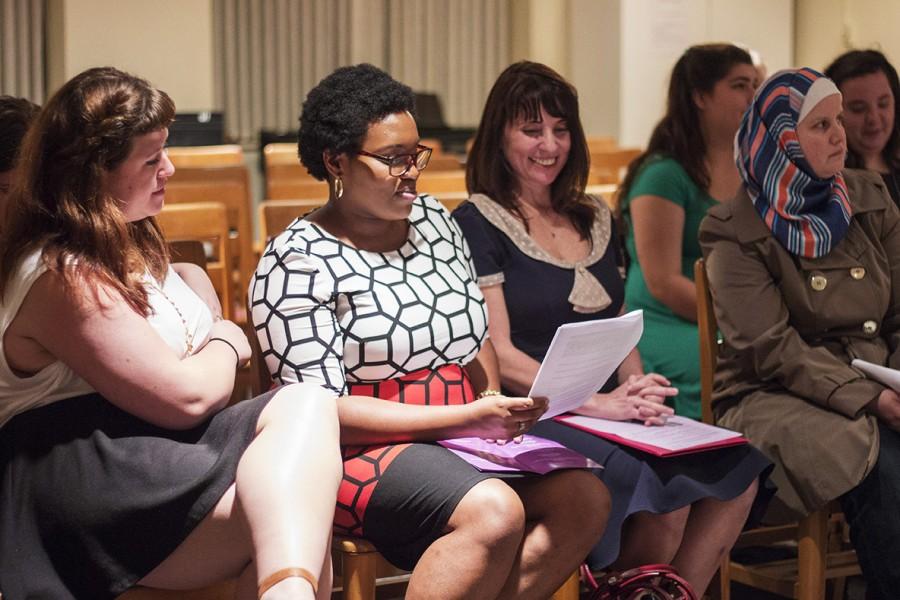
Lauren Poiroux, sociology senior, A'niya Robinson, political science senior, and Patricia Boyett, director of the Women's Resources Centre, read forth at the Interfaith Prayer Vigil on Tuesday March 8, 2016. The prayer vigil was a part of the Feminist Festival put on past the Women's Resources Center. Photo credit: Taylor Galmiche
At Loyola'due south feminist interfaith prayer vigil, "Celebrating the Feminine Divine in Me," students and professors got the take chances to explore their faith and what divine femininity means to them. Held in the Ignatius Chapel, the vigil began with a welcome from Patricia Boyett, director of Loyola's Women'due south Resources Center. The crowd was composed by and large of women, both students and professors. Boyett explained that the vigil would include cursory prayers or rituals from four dissimilar faiths: Judaism, Buddhism, Christianity and Islam, each led by a member of Loyola's community. Naomi Yavneh, manager of the Academy Honors Programme, represented Judaism and asked the crowd to stand. She led a song called "Ozi v'Zimrat Yah" whose lyrics loosely translate to, "My strength balanced with the Song of God will exist my salvation." Michaela O'Connor Bono, Resident Priest and Co-leader of the Mid-Metropolis Zen sangha, represented Buddhism and began by sharing the story of the Buddha'due south aunt, Mahapajapati Gotami, who demanded that women be allowed to become priests. She gathered 500 women and with them fought for the right to be ordained, eventually making the Buddha give in, according to Bono. The crowd and so learned nearly "Sophia," a theological concept for wisdom, from Laura Broders, Spiritual Managing director of the Ignatius Chapel Community, Alliciya George, communications inferior, and the Rev. Terri Zehyoue of the Christ Church Cathedral. Broders explained that in Christianity Sophia is another aspect of God that is largely ignored as a outcome of patriarchal themes within the religion. George and Zehyoue and so led two prayers: one call-and-response and one communal. Samar Sarmini, PhD, from the Loyola Intensive English and International Program represented Islam. She discussed the way God transcends gender in Islam. While Sarmini said that Islam defines God equally separate from all of his creations, the wife of the prophet Muhammed was the source of many Islamic teachings, and tradition made it so Islam was seen as a masculine organized religion. Finally, Alvaro Alcazar, Liberation Theology professor and Director of Urban Partners for the Twomey Centre for Peace Through Justice, led an interactive interfaith prayer. Mary Arias, English freshman, attended the vigil and said it taught her a lot well-nigh women in organized religion. Arias went to a Cosmic schoolhouse before Loyola, but said she never heard that much about women in Church. Anahi Herazo, biological science freshman, described herself as a feminist and also as very religious, only never thought of combining the two. "Normally, people call back of men doing everything, men being priests," Herazo said. "It'south not all most men; it'due south besides nearly women." Elizabeth Goodine, professor of Women in Christanity, sees themes that run through both feminism and religious faith. Feminism focuses on liberation for all people, specifically women, and many religions too focus on that aforementioned idea, Goodine said. She points out that Christianity and all of the world'southward major religions have grown up in a patriarchal culture. Feminist scholars are working to reinterpret biblical women in a more empowering style and others are working within the Church to raise the position of women, particularly to permit them to be ordained within the Catholic Church, co-ordinate to Goodine. She said this piece of work is boring going. The importance of the vigil is expressed by Anne Daniell, who teaches Eco-Feminist Theologies. She begins by explaining the mode religions are shaped past the context in which they grow up. "Religions accept been very patriarchal throughout history," Daniell said. When religions start everyone must take leadership roles, women included; information technology is only every bit the faith becomes more institutionalized, that it becomes more patriarchal, Daniell said. According to Daniell, feminism tin be part of pointing out and criticizing that patriarchal culture. "Patriarchy should not be key to the religion," Daniell said. "Misogyny should non exist central to the faith. Human dignity should be what'south key to all religions, or one of the central themes." On the topic of divine femininity, both Goodine and Daniell were hesitant to run with the idea of a "female person God." "The divine is neither masculine nor feminine, so I would shy abroad from annihilation that interpreted that as a female God," Goodine said. Daniell brought upward the point that the concept of divine femininity is more than an consequence of representation than the actual identity of God. Daniell discussed the upshot of using simply male pronouns to refer to God. "It's not that you lot desire to supervene upon the maleness of God with the female, it'southward to open information technology upward," Daniell said. "If you can merely see the male person, and so even if you lot say yous know God isn't male, if that's the merely pronoun you lot use, yous're stuck in it, and you lot're really just imagining the male." She commented on how being able to see the "Ultimate Power" equally not merely masculine can change the whole image of God and allow u.s. to call back about power differently. She acknowledged that at that place are problems with expressing the feminine divine as the nurturing, caretaking function because it seems to perpetuate preexisting and oppressive ideas. Still, she maintains the importance of characterizing God in a style that women and girls tin can see themselves represented. "I think it's important to image the divine in a way that affirms a little girl—that affirms all of u.s.," Daniell said. A'Niya Robinson, political science senior, and Lauren Poiroux, folklore senior with a minor in women's studies, were on the committee that organized the vigil and gave their own reasons for its importance. Major religions tend to be male centered and feminine involvement is on the outskirts, Robinson said. For her, the idea of divine femininity is a style of rethinking her faith-life. "It'southward thinking and growing and evaluating," Robinson said. "It'southward bringing in the marginalized and putting them in the center." For Poiroux, the vigil brings new means of praying or acknowledging divinity. She also said that it tin can besides help people who have never connected with religion before find a deeper spirituality.
Source: https://loyolamaroon.com/10008328/religion/faith-and-feminism-meet-at-feminist-festival-prayer-vigil/
0 Response to "Till We Meet Again Elizabeth Goodine Lyrics"
Post a Comment