National Recognition to the Best in Public Art Projects Annually
By Jan Brennan
Public art plays an invaluable role in the process of community building. Not merely does it establish and beautify public spaces, it expresses and supports a sense of neighborhood history, civilisation and identity and helps drive economic vitality. 1 attribute of increasing interest is participatory public fine art, in which the public plays an agile role rather than merely being appreciative viewers.
Public Art Basics
Although nosotros often call back of outdoor murals and sculptures, public works of art can take any shape or form, use any artistic medium, including performance, be either permanent or temporary, located indoors or outdoors, and be integrated into the compages and site design or stand lone. Beautification, enrichment and enjoyment are valuable benefits of public art, but it is also frequently designed to drag cultural history, help address urban issues, support economical vitality and build customs cohesion.
Public fine art projects are nigh often site-specific works triggered past public construction and development projects. The most common funding machinery for municipal public art are percent-for-art ordinances, dedicating a pocket-sized per centum of majuscule improvement edifice or infrastructure budgets to fund public fine art associated with the project. Country and local budget appropriations, public and private foundation grants, corporate sponsorships and individual donations are also sources of support.
Public art processes are managed by a wide variety of entities responsible for public infinite, including cultural offices, parks and recreation departments, economic evolution entities, educational institutions, transit authorities, nonprofit organizations and fifty-fifty private developers. Public art option processes include direct commissions and choice through a competitive request for proposals or qualifications. Review and selection may be conducted by staff or an appointed selection panel, typically comprising both community members and arts professionals, with concluding blessing from a public art commission or department.
What Makes Public Art Participatory?
The role of the public in the public fine art procedure described above is limited, primarily as passive consumers of the finished public artwork. More than public art agencies are turning to participatory approaches that increase involvement and make public art more than reflective of the communities in which it is located. Artists are being asked to create works responsive to a specific expanse'due south culture, history and residents, rather than proposing artworks that could be dropped into any park or neighborhood.
Public art allows for varied participation, including public date in planning, selection, cosmos, installation, maintenance and collective appreciation. Participatory public art amend reflects neighborhood identity, culture and history. The shared experience of cosmos and interaction with public art builds customs cohesion. Participation amplifies the sense of ownership, discouraging graffiti and vandalism while supporting beautification, safety and economic evolution. At a time when public budgets are stretched thin, there is also a recognition that greater public participation increases voter support for public art programs and investments.
Strategies for Participatory Public Art
1. Participatory Planning
Municipal and regional planning for public fine art is the first opportunity for public participation. Plans are typically driven by staff, but public input helps ensure public fine art programs align with community priorities and values and can help improve public fine art access and impact.
1 claiming of public fine art planning is the popular percent-for-fine art funding mechanism, which links new artworks to the physical location of capital letter improvement projects. This approach may concentrate public art in downtown areas and new developments, leaving established residential and depression-income areas as public art deserts. A practiced opportunity for public participation in planning is to help identify and accost inequities in public art across the programme geography and constituents. Consider changes to policies which limit use of all percent-for-fine art funding narrowly to the concrete location of uppercase projects, cosmos of an alternative public art funding machinery for areas with little new construction or creation of mobile collections and loan programs that can help get public artworks into under-served locations.
Another valuable impact of participatory planning is to challenge the traditional Eurocentric orientation of many public fine art collections. Public art programs should monitor the diversity of both their art collections and selected artists to assess whether they are inclusive and representative. Public artworks have also go more than diverse in subject area, for example, including more textiles, digital media and performance works. Public participation can play a valuable role in assessing and planning that increases diversity and cultural pluralism reflected in public art.
A concluding participatory art planning opportunity is presented by public budgeting. Equally with other areas of public budgeting, public fine art is an area in which the public can exist invited to direct neighborhood investments and improvements. Chicago residents have several opportunities to directly the investment of public art funding. The Rogers Park Business organisation Brotherhood highlights local public art projects developed through participatory budgeting.one
Activeness ITEMS
- Gather public input to identify art deserts and generate ideas to improve equitable access to public art.
- Consider alternative funding mechanisms and mobile drove or loan programs that tin help provide public fine art in areas without major capital projects.
- Include public input into assessing the diversity and inclusiveness of your public art collection and artists and identifying gaps.
- Allocate public art funds that tin can be directed through participatory budgeting to allow residents more input into the artworks in their neighborhoods.
ii. Participatory Selection
Current public fine art models most often include community participation in the option process. While formal arts expertise is important, most public entities accept opted for a balanced approach, ensuring artistic skills and experience while likewise including locals on site-specific selection committees. Denver Public Art, for case, appoints option panels with a "balance of customs members who live or work near the project site and members who are more than widely experienced and knowledgeable most art."2 This is a beneficial do, providing the selection committee with local input and heightening the responsiveness of public fine art to neighborhood context, history and civilization.
The Metropolis of Tampa, Florida includes both customs and arts knowledge in criteria for participation in public art selection panels. Criteria for arts expertise includes "experience implementing public art projects; knowledge of public art trends and artists; knowledge of local, regional and national artists; ability to assess the inventiveness, design skills and problem-solving abilities of the artists under review; and knowledge of materials and methods of fabrication." The value of customs is besides recognized, including criteria such as "experience and interest in working with Tampa'due south communities; ability to represent neighborhood where the projection is located; and power to work cooperatively and effectively in a console process."
Tampa'south policy also calls for "cultural, racial and gender variety," and provides for non-voting participation from "community groups or other interested parties."3 While inclusion of customs representatives in public art selection panels offers some participatory opportunities, such opportunities are typically limited to a few individuals who are recommended for choice panel membership by the public art staff.
Some communities have allowed the public to more broadly participate in public art choice. Wheeling, Ohio, Gilded, Colorado, and Seattle, Washington, last year allowed community members to select amidst finalists from public art commissions. The common arroyo to balancing expertise and customs participation in these cases is to have arts professionals identify finalists, from which the popular vote determines the winner.
In reviewing policies related to art option panels, improvements might clarify a commitment to public input in the option process, share benefits of public engagement, clarify how diverse community representatives will be identified and included in the selection process and ensure criteria are in place which values both arts experts and customs representation.
Action ITEMS
- Review and update your art option panel policies to permit or enhance customs representation.
- Ensure that customs members are aware of opportunities to participate in the pick process and how to put themselves forrard.
- Expand your public art plan pool of community representatives to be more inclusive and diverse.
- Consider opportunities for public selection of artworks through voting. Public voting would typically occur amidst finalists identified past qualified experts to ensure appropriate blueprint and materials.
3. Participatory Creation
Certainly one of the most exciting aspects of participatory public art is the trend towards engaging the public directly in the creative process. At that place are three primary models for participatory arts creation: collaborations in which the public works closely with the artist to inform development of the artwork; projects in which the public directly participates in creating the artwork; and projects in which the artwork is only realized through public interaction. Participatory cosmos is not new, just it is an area of rapid expansion in public fine art. Public fine art programs are stepping upward to promote and facilitate public engagement, rather than only relying on the artist to deport community outreach and enquiry to inform their public art proposal or projection.
Let'south examine a few contempo public art projects which used participatory creation. Several of the models are drawn from Americans for the Arts' Public Fine art Network and Year in Review Database,4 a fundamental source for best models of innovative public art.
Philadelphia's Landscape Arts Programme has helped brand them as the "City of Murals." Mural Arts annually engages residents to create 60 – 100 murals. As in many cities, Philadelphia'due south mural plan originated through anti-graffiti efforts. Fishtown'southward newest mural Welcome to the Neighborhood demonstrates several participatory elements. First, the mural pattern was created through a public contest open up to anyone and the selection was based on voting by over ii,000 residents. Going beyond public input and voice, the project included public paint days in which neighborhood volunteers directly participated in creating the mural, which features a collage of current and historic Fishtown leaders and locations.
Pathways to Liberty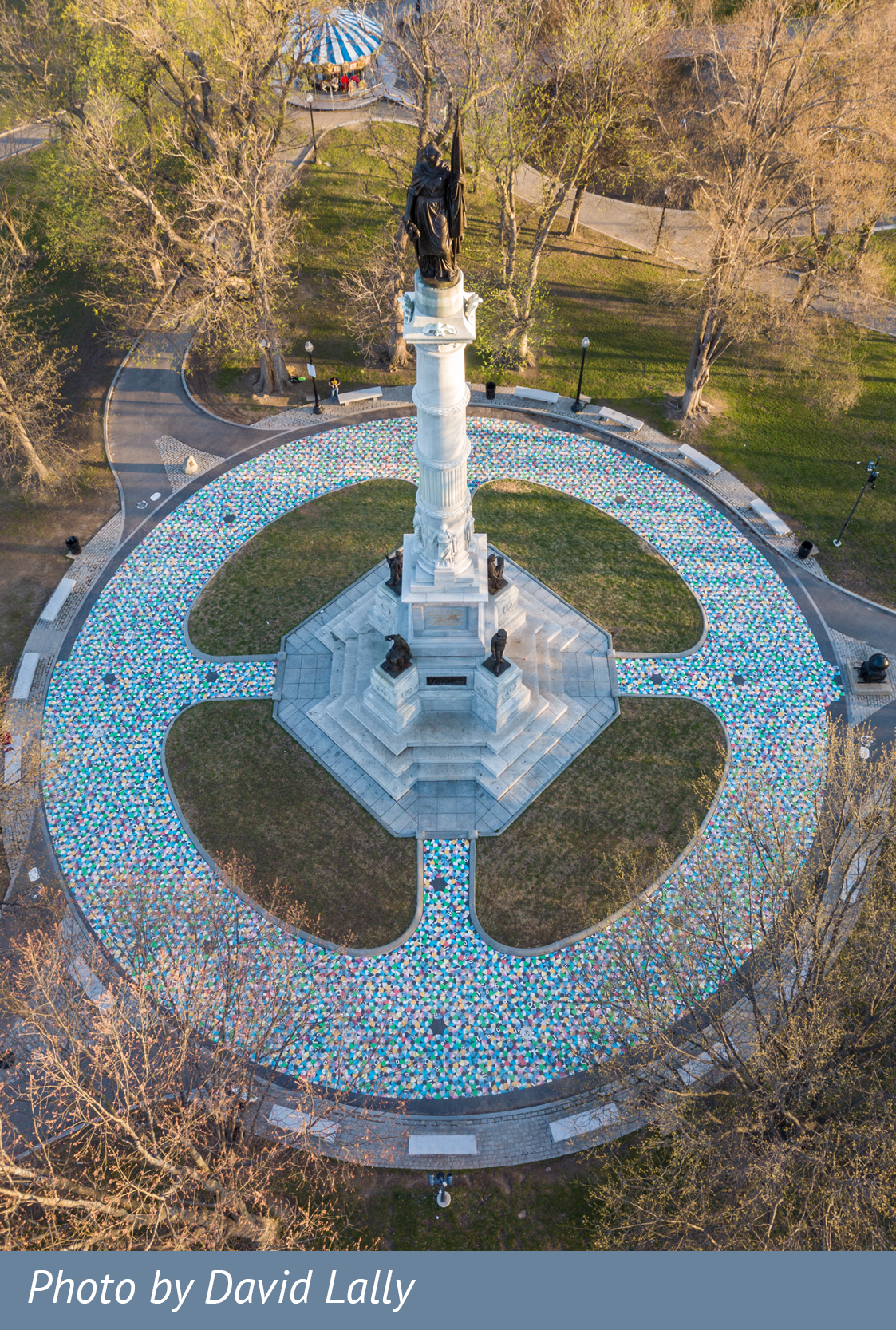 (Boston, Massachusetts) was a temporary installation on Boston Common during Spring 2018. Sculptor Julia Vogl engaged ane,800 residents at 27 customs locations to direct participate in creating the artwork. Each person created a round pin with stickers representing their responses to questions regarding freedom and immigration. Vogl then incorporated the pin designs into a 6,000 ft. public installation covering the pathway around the Soldiers and Sailors Monument. Over 25,000 individuals visited the art projection, which besides included sound stories recorded by residents.
Poetry on Buses (Seattle, Washington) featured resident poems on buses, lite runway and streetcars through a collaboration of transit agencies, the Seattle 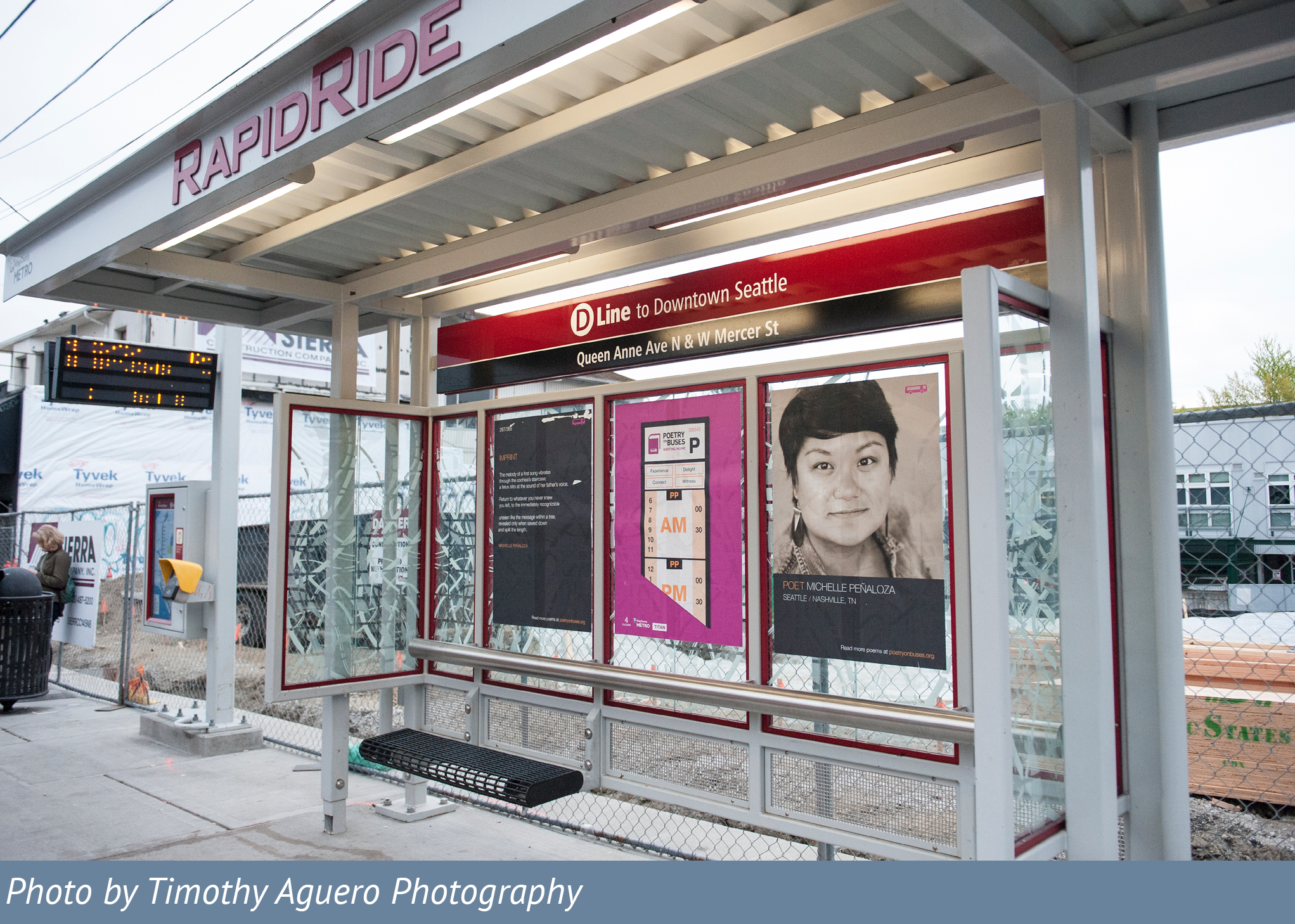 Office of Arts & Culture and King County cultural agency in 2016 - 2018. Customs Liaisons conducted outreach and verse workshops in diverse indigenous communities based on the theme "Torso of Water" established by artist Jourdan Keith. Over 1,600 original poems were submitted, from which 365 were selected for the project and 125 were displayed in transit vehicles and stations.
When West Hollywood, California, completed a community-based cultural plan in 2017 Sean Noyce was one of the artists commissioned to create artworks based on visualization of public input to the plan. His Dream Cloud balloons and other artworks show word clouds based on the words that were most oftentimes used during the input process. The public not merely informed the plan through their input, they had the risk to come across their cultural input flight high.
When St. Louis wanted to engage the public with municipal data, they turned to artist Jer Thorpe. His St. Louis Map Room public fine art project allowed 29 groups of residents to create maps reflecting their lived experiences of the city. Residents mapped their realities, from their routes to work or school and service locations they access, such as food banks, churches and parks, to areas of the metropolis they considered safe and those they considered unsafe. Resident maps were then overlaid with city information, ranging from poverty statistics to omnibus routes. The project, which has been recreated in other cities, used public fine art to seed important community conversations, empower residents and allow groups to feel the metropolis through the optics of their neighbors.
This fall, Old Town Alexandria (Virginia) has featured an interactive public artwork Mirror Mirror, commissioned by the City's Office of the Arts. The 25-foot long, eight-human foot alpine installation is sound-responsive. Viewers clap, stomp and shout to produce bright rainbow hues, posing for selfies and enjoying local music performances that take advantage of the space. This is an example of an artwork that is intended to exist activated and realized through public interaction with the piece of work.
Action ITEMS
- Review public fine art policies to ensure they permit or encourage new technology and innovative art forms that facilitate public participation and interaction.
- Provide mechanisms to make the public aware of upcoming public art projects and solicit their feedback.
- Craft upcoming public art requests for proposals or qualifications to prioritize participatory and interactive public proposals.
- Offering a workshop for prospective public artists to increase their understanding and use of participatory and interactive approaches.
4. Participatory Maintenance
Maintenance of public artworks is a quaternary opportunity for public participation. Public fine art staff are oft challenged to monitor the condition of big public art collections distributed throughout a city, region or state. Programs can benefit by facilitating participatory monitoring and data collection. Seattle's Office of Cultural Diplomacy Public Art Programme maintains a tip line to report works in need of repair and offers workshops in artwork stewardship for interested volunteers, guiding them in inspection, reporting and some routine cleaning. By offering proactive workshops, the Public Art Programme hopes to discourage well-intentioned, but often damaging attempts by the public to remove tagging from artworks.
Action ITEMS :
- Create and promote a telephone line and email for the public to study vandalism or harm to public artworks. This should exist coordinated with graffiti reporting.
- Create a community workshop to help volunteers effectively back up condition assessment and unproblematic cleaning of public art.
- Plant a public art volunteer group to systematically monitor and report on the condition of works in the public art collection.
v. Participatory Collective Appreciation
A terminal expanse for participatory public engagement is through activities and events that promote collective enjoyment of the artworks and use them every bit a platform for community-edifice. "More than ever before, public artworks are stimulating and inviting agile dialogue rather than just passive observation," notes the Projection for Public Spaces, "thereby fostering social interaction that can fifty-fifty lead to a sense of social cohesion among the viewers."5
Ane aspect of collective appreciation is to drive understanding of artworks and how they reflect neighborhood culture and history. Public art programs don't finish once an artwork is installed. The public needs education and opportunities to appreciate the artworks, specially as a customs. You might depict inspiration from this National Arts Marketing Projection video How to Await at Public Art: A Six-Year-Old-Explains.6 A customs mural highlighting historic figures and events can be the platform to provide interpretive information that builds shared customs identity and civic pride. The Association for Public Art promotes Public Art Lesson Plans.seven Apps, maps and databases are cardinal aids, linking public artworks to boosted online content. Staff and volunteer docents can enrich the feel by conducting public fine art tours, with many communities adding wheel and scooter tours.
The human activity of meeting as a community to engage with public art drives placemaking and builds relationships and social capital. It is challenging to get together a group of residents to interact with a painting, simply participatory art is intended to provide rich engagement opportunities. Edifice programming and events around public fine art themes and spaces allows for richer, collective community experiences.
- Provide on-site and online interpretive materials, maps, apps and searchable databases that provide the public a greater appreciation of the artworks and their community context.
- Solicit and train diverse public representatives to offer guided experiences of artworks and promote these opportunities to all communities.
- Develop and promote lesson plans and educational materials aligned with themes in the public art collection.
- Organize regular community events that engage residents collectively with public artworks.
Conclusion
Participatory approaches tin increase the appreciation and impact of public fine art, accolade the history and culture of neighborhoods, provide collective cultural experiences and build residents' sense of buying and pride.
But participatory public art only works effectively when it is broadly and inclusively participatory. Public art programs can fall casualty to including a few "usual suspects" and neglect to reach and include audiences who are currently disengaged. Participatory public art is also only one pocket-sized component of community-building. "Public art projects will be most effective when they are role of a larger, holistic, multidisciplinary arroyo to enlivening a city or neighborhood," observe Kent and Niktin.eight
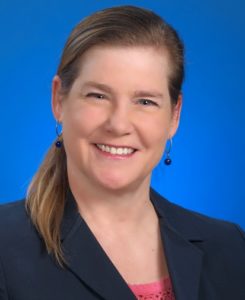
Jan Brennan is a Senior Beau of the National Civic League and Mountain West Managing director for the Campus Election Appointment Project. Jan's passion is to promote borough learning and engagement, from the classroom to public infinite, cartoon on her feel equally the Director of the Denver Function Cultural Affairs and Project Lead at the National Eye for Learning and Civic Engagement.
one Rogers Park Business Alliance. Public Art: Participatory Budgeting. Retrieved from https://rpba.org/public-art-participatory-budgeting/
ii Denver Public Art, FAQ, City of Denver, retrieved from https://denverpublicart.org/about/#faq-section
iii Tampa Public Fine art, Art Selection, retrieved from https://www.tampagov.net/art-programs/Programs/public-art/art-option
iv Public Art Network. 2018 Yr in Review Trends and Themes: Participatory and Performative. Retrieved from https://web log.americansforthearts.org/2019/05/fifteen/2018-pan-twelvemonth-in-review-trends-and-themes-participatory-and-performative
5 Kent, F. & Nikitin, K. (January 22, 2012). Collaborative, Artistic Placemaking: Skilful public fine art depends on good public spaces. Projection for Public Spaces, retrieved from https://www.pps.org/article/collaborative-creative-placemaking-good-public-art-depends-on-good-public-spaces
half-dozen National Arts Marketing Project. How to Look at Public Art: A Six-Year-Onetime Explains. Retrieved from https://namp.americansforthearts.org/by-topic/public-art/how-to-look-at-public-art-a-half dozen-year-old-explains
vii Association for Public Fine art. Public Fine art Lesson Plans. Retrieved from https://world wide web.associationforpublicart.org/resources/public-art-lesson-plans/
8 Ibid vi

Site Map
Latest from Twitter
@NationalCivic
"Inflation is at a 40-year high, meaning the cost of capital projects and fifty-fifty routine service delivery is going upwards." Despite fiscal challenges, @GOVERNING reports that local governments are in good shape and that the economy is growing. https://t.co/9fqBJ0Q0eI
Amazon Smile
With your help, the League can help increase borough appointment to build equitable, thriving communities. Donate to the League
Source: https://www.nationalcivicleague.org/ncr-article/public-art-and-the-art-of-public-participation/
0 Response to "National Recognition to the Best in Public Art Projects Annually"
Post a Comment